

Managing a growing service business requires more than simply assigning technicians to customer locations. Service companies need to coordinate customer requests, appointments, technicians, inventory, invoices, service contracts, and follow-ups while maintaining a high level of customer satisfaction. As the number of customers and field employees increases, manual processes can become difficult to manage.
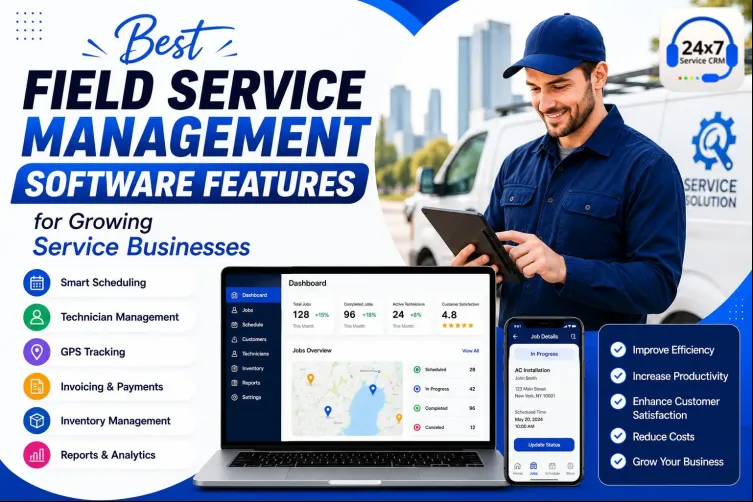
This is where Field Service Management Software can help. A modern field service solution provides a centralized platform for managing field operations, improving technician productivity, tracking service requests, and delivering better customer experiences.
Also known as FSM Software, Field Service Management Software is useful for businesses that provide installation, repair, maintenance, inspection, and other on-site services. When integrated with a Service CRM, it can connect customer relationships with field operations and create a complete service management workflow.
What Is Field Service Management Software?
Field Service Management Software is a digital solution designed to manage service activities that take place outside the office. It helps businesses coordinate customers, service requests, field technicians, schedules, equipment, spare parts, invoices, and service reports.
Industries such as HVAC, electrical services, appliance repair, medical equipment maintenance, solar installation, water purifier services, facility management, and industrial equipment maintenance can benefit from FSM Software.
Instead of managing field operations through spreadsheets, phone calls, emails, and paper forms, businesses can use one centralized system to organize their service processes.
Why Growing Service Businesses Need FSM Software?
As a service company grows, its operational complexity also increases. More customers mean more service requests, while a larger technician team requires better scheduling and coordination.
Manual processes can lead to missed appointments, inefficient technician routes, delayed service responses, incomplete records, and billing errors.
Field Service Management Software automates many of these activities and gives managers real-time visibility into service operations. This allows businesses to handle a larger customer base without increasing administrative workload at the same rate.
Best Field Service Management Software Features
1. Customer Management
A centralized customer database is one of the most important features of FSM Software. Businesses can store customer contact information, addresses, service history, equipment details, contracts, invoices, and communication records.
Service teams can quickly access customer information when a new service request is received. This improves response time and allows technicians to understand the customer’s previous service requirements.
2. Service Request Management
Customers may contact a service business through phone calls, websites, emails, or other channels. Field Service Management Software allows teams to convert these requests into organized service tickets.
Each ticket can contain information such as customer details, problem description, priority, location, assigned technician, appointment time, and job status.
Managers can track tickets from creation to completion, reducing the possibility of missed or forgotten service requests.
3. Smart Technician Scheduling
Technician scheduling becomes increasingly complicated as a business expands. Managers must consider availability, technical skills, location, workload, and appointment commitments.
FSM Software helps managers assign jobs to the right technicians based on these factors. A well-planned schedule can reduce travel time, avoid appointment conflicts, and improve the number of jobs completed each day.
4. Dispatch Management
Effective dispatching ensures that technicians receive accurate job information at the right time.
With centralized dispatch management, service managers can view open jobs, technician availability, job priorities, and service locations. They can assign or reschedule work quickly when customer requirements change.
This improves coordination between office teams and field employees.
5. Mobile Access for Field Technicians
Field technicians need access to service information while working at customer locations. A mobile-friendly FSM platform allows technicians to view job details, customer information, equipment records, previous service history, and instructions.
After completing a job, technicians can update the service status, add notes, record parts used, upload images, and capture customer confirmation directly from the field.
This reduces paperwork and improves the accuracy of service records.
6. Real-Time Job Tracking
Managers need visibility into what is happening in the field. Real-time job tracking allows them to monitor assigned, in-progress, pending, and completed service requests.
This information helps managers identify delayed jobs and take action quickly. Customers can also receive more accurate updates about technician arrival and service progress.
7. Preventive Maintenance Scheduling
Many service businesses generate recurring revenue through maintenance contracts. Preventive maintenance scheduling helps ensure that regular inspections and servicing are completed on time.
Businesses can create recurring maintenance schedules based on equipment requirements, service intervals, or contract terms.
Automated reminders help prevent missed service visits and improve equipment reliability.
8. Inventory and Spare Parts Management
Field technicians often require spare parts and consumables to complete service jobs. Poor inventory management can delay repairs.
FSM Software can track available stock, parts issued to technicians, parts used during jobs, and purchase requirements.
Better inventory visibility helps companies maintain appropriate stock levels and reduce unnecessary service delays.
9. Estimates, Invoices, and Payments
A complete field service platform should support financial workflows. Technicians or office staff can create estimates based on labor, parts, travel charges, and other service fees.
After the job is completed, the system can generate invoices and track payment status. This creates a smoother process from service request to payment collection.
10. Service History and Asset Management
Businesses that maintain equipment need accurate asset records. FSM Software can store information such as equipment type, model, serial number, installation date, warranty, maintenance schedule, and previous repairs.
A complete service history helps technicians understand recurring problems and make better repair decisions.
11. AMC and Contract Management
Annual Maintenance Contracts (AMCs) are an important source of recurring revenue for many service companies.
Field Service Management Software can track contract start dates, expiry dates, service frequency, covered equipment, and scheduled visits. Automated renewal reminders help businesses contact customers before contracts expire.
This can improve customer retention and increase recurring service revenue.
12. Reports and Analytics
Data-driven decision-making becomes increasingly important as a service business grows. FSM Software can generate reports related to technician performance, service response time, job completion rates, equipment downtime, revenue, spare parts consumption, and customer service activity.
Managers can use these insights to identify operational bottlenecks and improve business performance.
How Service CRM Complements Field Service Management Software?
A Service CRM connects customer relationship management with field service operations. While FSM Software focuses heavily on field activities, a Service CRM provides a broader view of customer interactions and service relationships.
For example, when a customer submits a service request, the CRM can provide customer information and service history. The request can then be converted into a field job and assigned to a technician. After completion, the service report, invoice, and follow-up information can be stored against the customer’s profile.
This creates a connected customer journey from inquiry to service completion and future maintenance.
Benefits of Field Service Management Software
Implementing FSM Software can provide several benefits for growing service businesses:
· Faster service response
· Better technician productivity
· Improved appointment scheduling
· Reduced administrative work
· Better customer communication
· Lower travel and operational costs
· Improved spare parts management
· Accurate service documentation
· Better AMC renewal management
· Faster invoicing and payment tracking
· Improved customer retention
· Real-time management visibility
These benefits can help service companies scale their operations while maintaining consistent service quality.
How to Choose the Right FSM Software?
Before selecting Field Service Management Software, businesses should evaluate their service workflow and future growth requirements.
Important factors include ease of use, mobile accessibility, customer management, scheduling, dispatching, technician tracking, inventory management, preventive maintenance, invoicing, AMC management, reporting, and Service CRM integration.
The solution should also be scalable so that additional users, technicians, locations, customers, and service processes can be added as the business expands.
Conclusion
Growing service businesses need efficient systems to manage increasingly complex field operations. Manual scheduling, paper-based service reports, spreadsheets, and disconnected communication can limit productivity and create unnecessary operational challenges.
Field Service Management Software provides a centralized solution for managing customers, service requests, technicians, schedules, inventory, maintenance, invoices, and service history. The right FSM Software can help businesses improve field productivity, respond faster to customers, and build more organized service operations.
When integrated with a Service CRM, businesses can connect customer relationships with field service activities and create a complete end-to-end service management process.
By adopting the right technology, growing service companies can improve efficiency, strengthen customer relationships, increase recurring revenue, and build a scalable foundation for long-term business growth.